Whatever goes on your skin stays there for hours. Here is how to prioritise leave-on products, read an ingredient list properly, and tell a real certification from a marketing word.
Personal care is the category where the “dose makes the poison” argument gets most interesting. Individual products contain small amounts of any given ingredient. But most people use six to twelve of them every single day, many of them leave-on, applied to skin that is warm, damp, and freshly exfoliated.
The useful question is not whether one moisturizer is dangerous. It is what your total daily load looks like, and which products are worth attention first.
This single distinction should drive almost every decision you make here.
A cleanser is on your skin for sixty seconds and then goes down the drain. A body lotion stays for sixteen hours. A deodorant sits in a warm, occluded area with a compromised barrier from shaving. If your budget is limited, spend it on the products that stay.
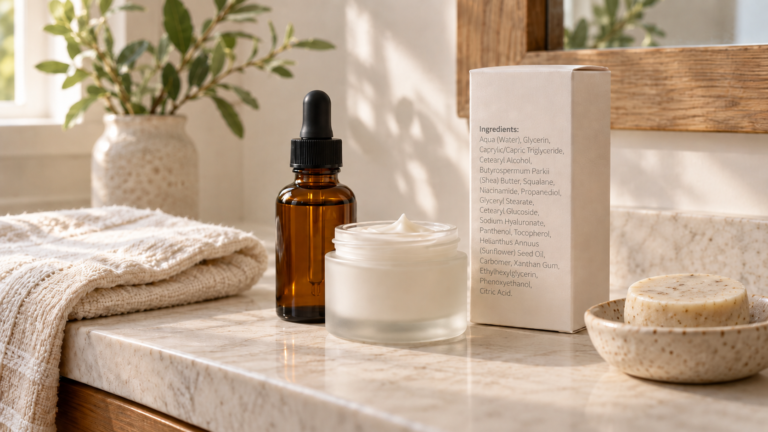
Ingredients appear in descending order by concentration down to one percent, after which they can be listed in any order. This makes the list far more informative than most people realize.
Anything in the first five ingredients is a meaningful proportion of the product. Anything appearing after the preservatives and fragrance is present in trace amounts — which is worth remembering when a brand markets a hero botanical that sits second from the bottom.
The cheapest improvement in this category is using fewer products, not swapping each one for a pricier version.
Most skincare routines contain redundancy. A gentle cleanser, one moisturizer, and a mineral sunscreen covers the actual needs of most skin. Every product you remove is an exposure removed and money saved, and it also makes it far easier to identify the culprit when something irritates you.
No. Water is a chemical, and so is every ingredient in every product ever made. The phrase signals marketing rather than information. Judge the specific ingredients instead.
Not reliably. Essential oils and botanical extracts are among the more common causes of allergic reactions in cosmetics, while many synthetics are inert and well studied. Origin is not a useful proxy for safety.
No. Finish what you own and upgrade at repurchase, starting with your leave-on products. Replacing a half-used lotion accomplishes very little.
Worth more caution, because of a higher surface-area-to-weight ratio and a developing skin barrier. Fragrance-free is the most valuable rule here, and plain products with short ingredient lists usually beat anything marketed specifically at babies.
If you are new to this, the Beginner’s Guide to Non-Toxic Living explains where personal care sits relative to everything else, and why it ranks second after indoor air.
Deeper reads on each part of a personal care routine.