A simpler, more thoughtful laundry routine starts with knowing what to look for. This guide walks you through the ingredients I prefer to avoid, what common laundry labels really mean, and the easy swaps that can make the biggest difference.
A simpler, more thoughtful laundry routine starts with knowing what to look for. This guide walks you through the ingredients I prefer to avoid, what common laundry labels really mean, and the easy swaps that can make the biggest difference.
If you want the short version, start here:
You don’t need to change everything at once. Start with the product you’re about to run out of and go from there.
If you’re only going to change one product, detergent is a great place to begin.
It touches just about every washable fabric in your home, so I look for a formula that is:
I also like seeing EPA Safer Choice certification when it’s available.
This guide contains affiliate links. I may earn a commission if you buy through them — at no extra cost to you. As an Amazon Associate I earn from qualifying purchases.
Want a deeper look at ingredients, labels, and my favorite options?
Read: Best Non-Toxic Laundry Detergent: What to Look For & Avoid →
This is one of the easiest laundry swaps to make.
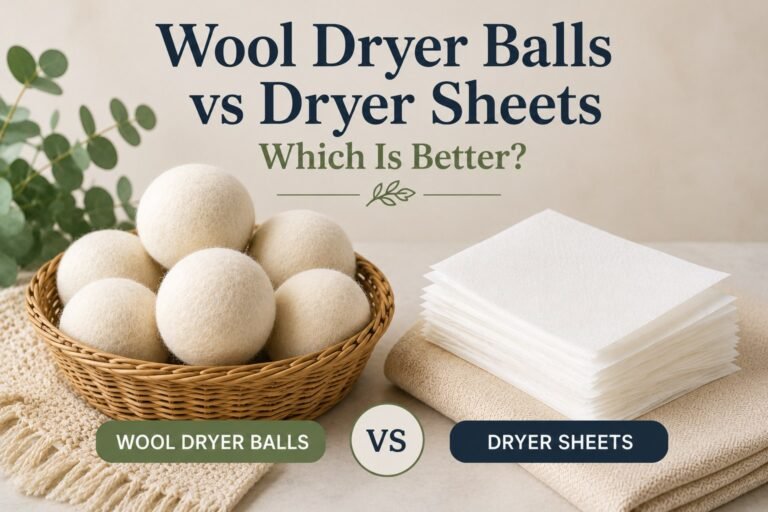
Traditional fabric softeners and dryer sheets work by leaving a coating on fabric to make it feel softer, reduce static, or add scent.
That coating can build up over time, especially on towels, athletic wear, and other fabrics designed to absorb moisture.
Instead, I prefer wool dryer balls.
They help separate clothing in the dryer so air can circulate more easily, and they can help reduce static without adding another product to your fabric.
My pick: Plant Therapy Wool Dryer Balls
Want to learn more?
You don’t need to memorize every chemical name on a bottle.
I focus on a handful of things that are relatively easy to spot.
Fragrance doesn’t make laundry cleaner—it simply makes it smell a certain way.
If you’re trying to simplify your routine, fragrance-free is one of the easiest places to start.
Dyes aren’t needed for cleaning performance, so I generally skip them.
Optical brighteners make fabrics appear brighter by interacting with light, but they don’t actually remove more dirt.
They’re simply an extra I prefer not to use.
These can build up on fabrics over time and reduce absorbency.
That’s another reason I prefer dryer balls over liquid fabric softener.
Want the full breakdown?
Laundry packaging is full of reassuring words:
Natural. Plant-based. Clean. Green. Free & Clear.
Unfortunately, those words don’t always tell you much about the complete formula.
Here are the labels I pay the most attention to.
A useful certification showing that ingredients have been evaluated against specific health and environmental criteria.
Another ingredient-screening certification you may see on some household products.
Usually means no added fragrance or dyes, but I still check the ingredient information when possible.
A helpful description, but not something I use as my only deciding factor.
For me, ingredient transparency matters more than the wording on the front of the bottle.
More detergent doesn’t automatically mean cleaner clothes.
Using too much can make detergent harder to rinse away and may contribute to buildup in both your clothing and washing machine.
Instead of automatically filling the cap, follow the amount recommended for your:
If your laundry feels stiff, soapy, overly scented, or coated, try experimenting with a little less.
This may be the easiest laundry swap of all—and it’s completely free.
For everyday whitening and brightening, I usually reach for oxygen bleach before chlorine bleach.
It can be useful for:
My pick: Oxygen Bleach
Always follow the product directions and check the care label before using it on delicate fabrics.
Want a deeper comparison?
This is one of the simplest habits to adopt.
New clothing, sheets, towels, and other textiles may carry residues from manufacturing, dyes, packaging, or finishing treatments.
I like giving them a regular wash before the first wear or use.
No fancy product needed.
Sometimes musty laundry has less to do with your detergent and more to do with the washing machine itself.
Front-loaders especially can hold moisture around the door and gasket.
After your last load, leave the door slightly open so the inside can dry.
I also wipe around the gasket occasionally.
It’s a small habit that can help prevent odors before they start.
You don’t need a shelf full of specialty products.
These are the basics I would focus on:
SHOP SEVENTH GENERATION FREE & CLEAR STAIN REMOVER
SHOP LAUNDRY JARS & ACCESSORIES
Think of this as a list to come back to when something you already own runs out—not a shopping list you need to buy all at once.
You don’t need to overhaul your entire laundry room this weekend.
If I were starting from scratch, I’d make changes in this order:
Even one change is still a change.
The goal isn’t a perfect laundry room.
It’s simply making more thoughtful choices over time.
Yes. Fragrance adds scent, not cleaning power.
The cleaning comes from ingredients such as surfactants and enzymes, so a well-formulated fragrance-free detergent can work just as well as a scented one.
Not automatically.
Sheets are convenient and easy to store, but I still judge them the same way I would any other detergent: by the ingredients and how well they clean.
No. If you like the feel of softer laundry, wool dryer balls are a simple alternative that doesn’t coat the fabric in the same way.
Fabric softener and excess detergent can both contribute to buildup.
Try washing them without fabric softener and make sure you aren’t using more detergent than necessary.
It may take a few washes for heavily coated towels to start feeling absorbent again.
Once you’ve simplified your laundry routine, the next natural step is the rest of your cleaning cabinet.
My Non-Toxic Cleaning Guide walks through everyday cleaning products, what I look for on labels, and the swaps I think are actually worth making.